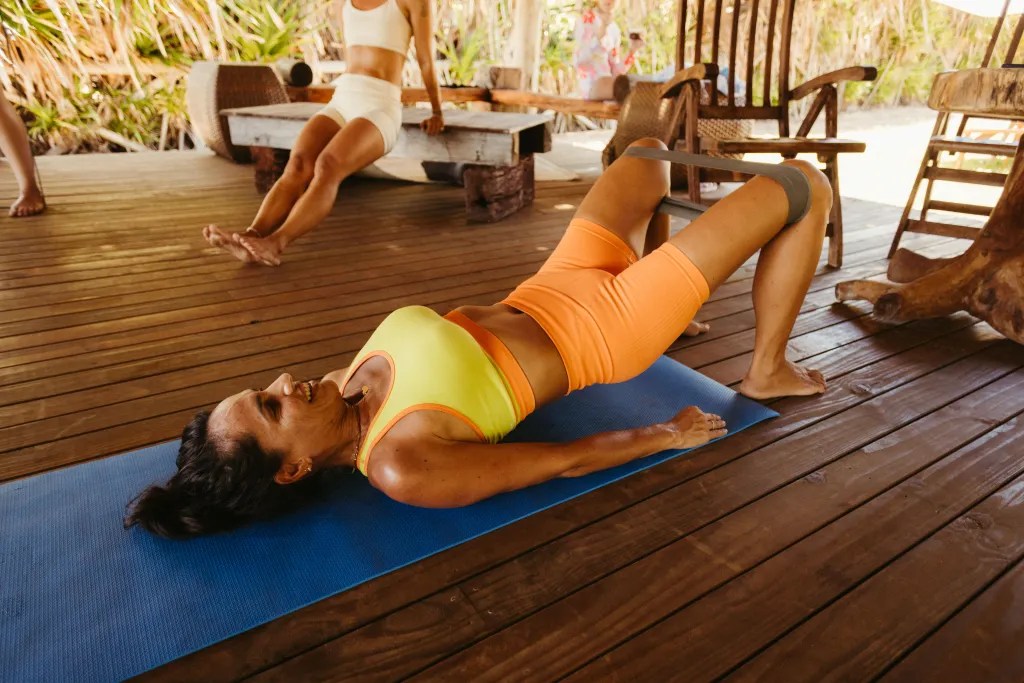
If you’ve ever done a glute workout and wondered why you can barely feel your bum working, you’re definitely not alone. You might be doing hip thrusts, squats, lunges and kickbacks, yet somehow your quads or hamstrings seem to be doing all the work.
You’ll often hear people talk about needing to “activate” or “wake up” your glutes, but sometimes the answer isn’t simply doing more glute activation exercises. Your foot position and the stability you create from the ground up can have a big impact on how well you are able to use your glutes during an exercise.
As a women’s personal trainer in Berkshire, this is something I pay close attention to when I’m looking at a client’s technique. Before we start thinking about whether your glutes are “firing”, it’s worth looking at the foundation you’re building your movement on — and that starts with your feet.
Your Foot is Your Foundation
When you’re standing, squatting, lunging or doing a single-leg exercise, your foot is your connection with the floor.
Think about your foot as a tripod. You want three main points of contact with the ground: your big toe, little toe and heel.
Rather than allowing your weight to roll onto the outside or inside of your foot, think about keeping all three points connected to the floor. This gives you a much more stable base to work from.
You don’t need to aggressively push your toes into the floor or grip the ground with them. Instead, think about maintaining contact through the big toe, little toe and heel while keeping your foot stable.
Once you’ve established that stable base, you have something solid to push against.
Why Does This Matter For Your Glutes?
Your body is constantly making adjustments to keep you balanced and complete the movement you’re asking it to perform.
If your foot isn’t stable, other muscles and joints may have to compensate to help you maintain that balance and produce force. Depending on the exercise and your individual movement pattern, you might find that you feel an exercise more in your quads, hamstrings or other areas rather than where you expected.
Creating a stable foot doesn’t magically switch your glutes on, but it can give you a much better foundation from which to use them.
Think about building a house. You wouldn’t start by worrying about the curtains before making sure the foundations were solid. Your foot is part of the foundation of many lower-body movements.
The Tripod Foot in a Squat
Let’s take a squat as an example.
As you lower into your squat, you want to maintain contact with the floor through your big toe, little toe and heel. Your knees can then move in a way that works with your individual anatomy and technique, while your foot remains stable underneath you.
As you drive back up, you’re able to push into the floor from a more stable position.
This doesn’t mean you should obsess over keeping your feet completely rigid. Your feet are designed to move and adapt. The idea is simply to maintain a strong connection with the ground rather than allowing your weight to shift excessively onto one part of your foot.
That small change in awareness can make a surprisingly big difference to how a movement feels.
What Happens When Your Foot isn’t stable?
Imagine you’re performing a split squat and your front foot keeps rolling onto its outside edge. Your body still needs to complete the movement, so it may find another way to create stability and generate force.
You might shift your weight, change the position of your knee or alter your hip movement without even realising you’re doing it.
Again, this isn’t necessarily “wrong”, and bodies are very good at finding ways to complete a movement. But if you’re trying to get stronger in a particular pattern, improving your base can give you a better starting point.
Instead of thinking, “Why can’t I feel my glute?”, it can be more useful to ask, “Is my foot giving me a stable base to push from?”
This Can Be Particularly Useful in Single-Leg Exercises
The tripod concept becomes even more noticeable during exercises such as lunges, Bulgarian split squats, step-ups and single-leg Romanian deadlifts.
When you’re balancing on one leg, you have a much smaller base of support than when both feet are on the floor. Your body has to work harder to control your position.
Keeping your big toe, little toe and heel connected to the ground can help you create a more stable platform.
From there, you can focus on the movement itself rather than constantly fighting to maintain your balance.
This is one of the reasons I don’t want clients to rush through exercises simply to get their repetitions done. Sometimes slowing things down and paying attention to where you’re putting your foot can completely change the quality of a movement.
You Don’t Necessarily Need More Glute Activation Exercises
If you feel your glutes aren’t working, the natural reaction is often to add more activation exercises to your workout.
You might start doing endless glute bridges, banded walks, clamshells and kickbacks before you even touch your main exercises.
These exercises can have a place in a training programme, but they aren’t necessarily the answer to every glute problem.
Your glutes aren’t simply an on/off switch.
They are already working when you walk, climb stairs, squat, run and perform countless other movements. The question is whether you’re creating the right conditions to use them effectively during the exercise you’re performing.
Sometimes the solution is less about adding another five-minute activation circuit and more about improving your technique.
Think From the Ground Up
When I’m helping someone improve their technique, I don’t just look at the muscle they’re trying to target.
Movement doesn’t happen in isolation.
Your foot interacts with the floor, your ankle influences what happens further up the leg, your knee and hip work together, and your trunk provides another part of the system. Small changes lower down can influence what happens further up.
That’s why I love the idea of thinking from the ground up.
Start with your foot. Create that tripod through your big toe, little toe and heel. Find a stable base. Then think about how you’re moving from there.
It doesn’t need to be complicated.
Your Glutes Aren’t Necessarily the Problem
If you don’t feel an exercise in your glutes, that doesn’t automatically mean your glutes aren’t working.
Muscle sensation can be useful feedback, but it’s not the only way to determine whether an exercise is effective. You can make progress without feeling an enormous burn in the target muscle every time you train.
Instead of constantly chasing the biggest burn possible, pay attention to your technique, your range of motion, your control and whether you’re gradually becoming stronger.
And if something doesn’t feel right, that’s where having someone assess your movement can be really useful.
This is Where Coaching Can Help
As a women’s personal trainer in Berkshire, I don’t want to simply give you a list of exercises and tell you to get on with them.
If you’re struggling to feel an exercise where you expect to, we can look at what’s actually happening during the movement. That might mean looking at your foot position, how you’re distributing your weight, your range of motion, your setup or how you’re controlling the exercise.
Sometimes a tiny adjustment can completely change how an exercise feels.
And importantly, you don’t need to spend hours trying to diagnose yourself from TikTok videos. Your body isn’t necessarily doing something “wrong” just because you don’t feel the exact sensation someone else describes online.
Build Your Movement From the Ground Up
The next time you’re performing a squat, lunge, split squat or another lower-body exercise, take a moment to think about your feet.
Can you feel your big toe, little toe and heel connected to the floor?
Can you maintain that connection as you move?
Can you create a stable base before worrying about what the rest of your body is doing?
A stable foot gives you a solid foundation from which to produce force and control your movement. From there, your glutes have a better opportunity to do their job rather than your body constantly finding other ways to compensate for a less stable base.
And that is often much more useful than simply asking yourself, “Can I feel my glutes?”
If you’re looking for a women’s personal trainer in Berkshire and want help improving your technique, getting stronger and feeling more confident in the gym, use my contact form to send me a message. We can look at where you’re currently at and build your training around you, rather than relying on generic exercises and hoping for the best.
Your glutes might not need another activation exercise. They might just need a better foundation to work from.


Leave a Reply